

“Tell me about a time you failed.”
You don’t want to look bad, so you find something safe. “We missed our deadline by a week, but recovered quickly.” And you can see it on the interviewer’s face, they’re writing “maybe not enough senior-level exposure” in their notes.
So next time you go bigger. “I misjudged the technical complexity, didn’t realize that we’d need to re-architect the entire data layer, and we were delayed by 6 weeks.” Now they’re looking at each other, “not sure if the candidate can lead a team on complex projects”
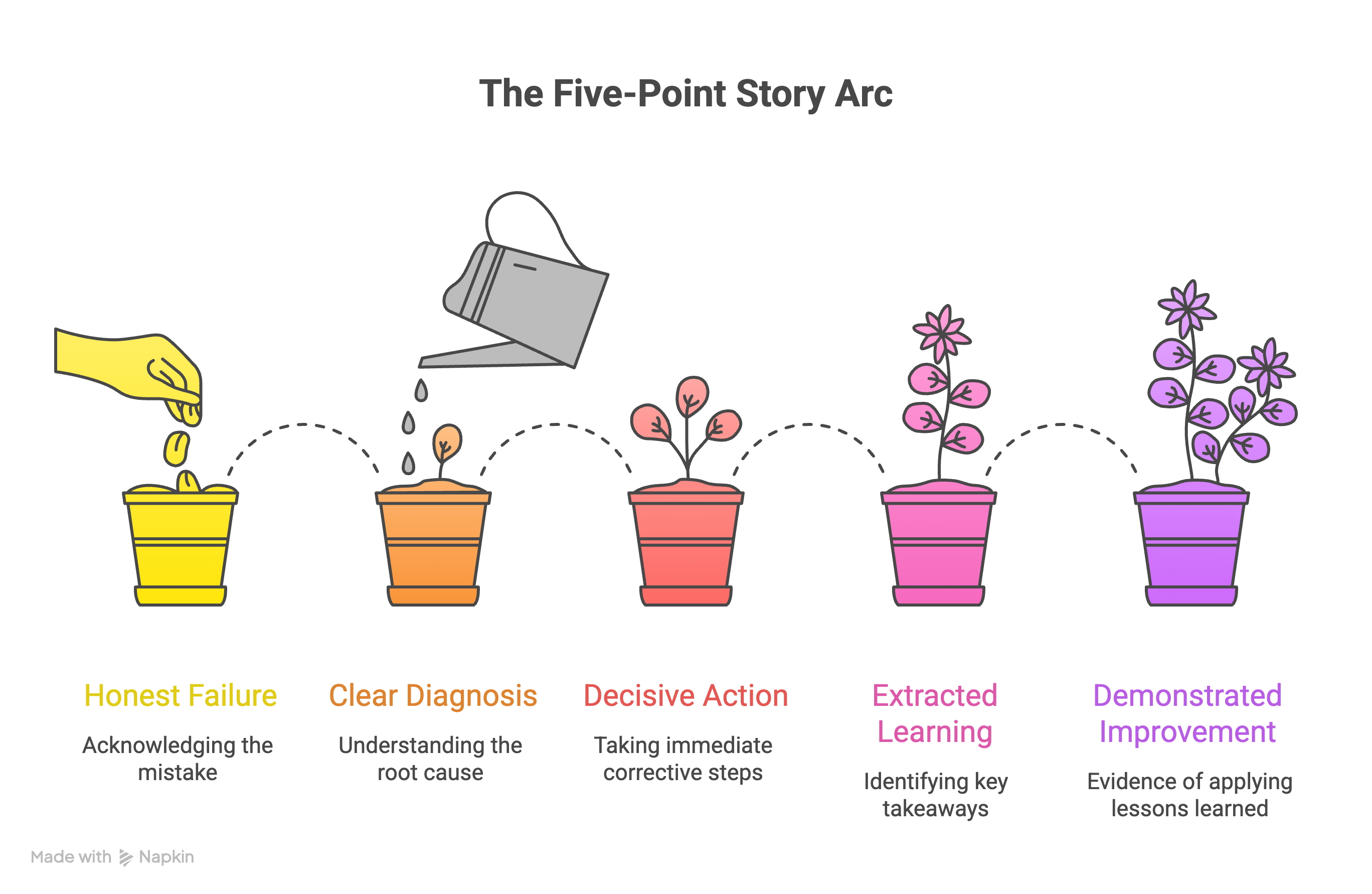
On the surface it seems that the problem with these answers is that they're too safe or too honest. However, the real problem is that they're both incomplete. Ideally, your answer should cover the following 5 points:
State the failure clearly
Explain what caused it
Show what you did when you realized it
Share the lesson you extracted
Show how your behavior changed afterward
I’ve been at big tech for 10+ years now and been on both sides of probably 200+ interviews. Just wrapped a cycle with EM offers from Meta, Netflix, and Airbnb, but also bombed at Doordash and Pinterest because I didn’t prep. Figured I’d write down what I picked up along the way while it’s fresh. This is a part of my question-by-question behavioral interview series, see all the questions here.
If you’re looking for sample answers, see my related posts:


The five-part story arc (with examples)
You can ensure that you answer is complete with humility + agency with the following 5 point arc:
Honest failure: This is where humility starts, higher stakes for higher roles. You state the actual failure, in words you’d use talking to a friend. “I misjudged the technical complexity, didn’t realize that we’d need to re-architect the data layer, and we were delayed by 6 weeks.”
Clear diagnosis: You’re showing you root caused and now understand the specific decision or assumption that made the failure preventable. “I assumed the other team understood our timeline because it was in the doc. I never confirmed they’d actually read it.”
Decisive action: This is where agency kicks in. What did you do when you realized things were going sideways? “I called an emergency sync with all three blocked teams, reset expectations with my director, and we shipped a stripped-down version in two weeks.”
Extracted learning: The actual thing you now understand that you didn’t before. You had a gap, and now you can name it. “I learned that being technically right isn’t enough. I was so focused on proving my approach would work that I forgot to make room for others to shape it.”
Demonstrated improvement: Proof you’re not the same person who made that mistake “In my most recent 360, three different peers mentioned that I make them feel heard before pushing for a direction. That’s not something anyone would have said about me before.”
If you skip any one of these, the interviewer will feel that something’s off.
Example Story
We were building a new personalization feature that required ingesting customer behavioral signals from across multiple surfaces. I knew privacy review was part of the process, but I treated it like a checkbox for the endgame.
Six weeks later, when the Privacy team reviewed our architecture, they flagged that the way we were storing and joining customer signals didn’t meet their data isolation requirements. The fix required reworking how we partitioned and retained data, which meant re-opening design decisions with a dependency team.
We slipped by a month, and my team had to redo work they’d already shipped. The marketing partners waiting on us lost a launch window.
The privacy team’s concerns were completely reasonable. If I’d brought them in during early design, we would have designed around the constraints from the start instead of retrofitting around them later.
What I changed: I now start a privacy review thread as soon as there’s early alignment on a project and the design is largely approved - before any engineering work begins. It adds maybe a week to the front of the timeline, and has saved significantly more on every project since.
Where most stories break
I have seen most failure stories break in two places:
They skip ownership. The failure gets framed as bad luck, bad timing, bad circumstances, or the story stays safely in “we” language throughout (read more about the “we” problem). The interviewer’s thinking: When things go wrong here, are they going to blame the team / leadership / organization? At Amazon and Netflix, where individual accountability is baked into the culture, this can be disqualifying on its own.
They skip demonstrated improvement. The candidate articulates a great lesson - “I learned that stakeholder alignment is critical” - but ended there with any mention of anything changing for real. The interviewer’s wondering: Nice philosophy. But did it actually happen? Evidence of behavioral change does weighs much more than stated intentions.
Other FAQ
Is it okay to talk about a big failure in interviews?
Yes - bigger is usually better, especially for senior roles. That said, the bulk of your answer should be diagnosis, learning, and how you operate differently now. A lot of candidates slip into a blow by blow account of the what happened (oh and then the Privacy Program Manager said this, so I responded with that) - this is where you lose the interview. The interviewer moves on to the next question and you miss signaling skills they wanted to see.
Is it okay to mention that a dependency team made a mistake, or that leadership changed requirements?
Even if it’s true, it doesn’t produce the signals interviewers are scoring for. The moment you point outward, the interviewer stops hearing accountability. Name what you missed, what you would do differently. That’s the only part that moves the needle in a debrief.
How recent should the failure be?
Ideally within the last 1-2 years and relevant to the level you’re interviewing for - shows a growth mindset.
What if I haven’t had a major failure?
It can feel like that, especially if you’re looking for “catastrophes”. A failure doesn’t have to be a dramatic implosions, it could be a judgment call that cost the team a few weeks, or a relationship you let drift until it became a blocker, or a process gap you didn't see until it bit you. A project that shipped late, a hire that didn't work out, a technical bet that didn't pay off - all of these count.
Sometimes, a story that feels "too small" when you first think of it often ends up being the strongest once you unpack what you actually learned. Try running your stories through the the five-part arc, and send me a message if you still think you don’t have a story.
What Meta, Amazon, Netflix, Google, and other tech companies look for?
There is a whole range of variations that companies use for this question.
There are no strong company-specific patterns, but Google often takes the project lens: “Tell me about a time you had to change course after realizing your approach was wrong?”, Meta asks “What’s your biggest mistake as a manager?”, Amazon usually frames it through Ownership: “Tell me about a decision you made with limited data that turned out to be wrong?”, while Netflix wants “A hiring decision you regret”
At the mid IC level, the interviewers want to see you can learn from mistakes. For senior, staff, principal, and management roles, they’re evaluating whether you can own failures that affected teams, timelines, strategy; how you root caused the problem, and how your judgment improved after impact.
For EMs, this is often the a heavily weighted behavioral question in the loop. I’ve seen entire interview panels turn on it multiple times.
Different companies use different frameworks (Netflix Culture Memo, Googliness, Amazon Leadership Principles), but they are all screening for the same two traits: humility and agency.
Humility: you recognize when you’re wrong and own it without making it someone else’s fault.
Agency: you act, you learn, you change.
A failure story missing either one doesn’t land, no matter how smooth you sound.
Now audit yours
Do this now - take your strongest failure story, walk it through the five parts, and identify the weakest one.
That’s where your prep time should go before polishing language or delivery.