Behavioral Interview Scoring: The Dimensions FAANG Grades
The behavioral interview rubric - 10 dimensions that top tech companies score senior/staff/principal engineers and managers on, and how to prep to the gaps.


A behavioral interview feels like a conversation. You tell them about all the impressive work you’ve done, and the interviewer nods like they get it. BUT while you're talking, the they’re also filling out a scorecard, and every sentence you say checks another box - for or against.
If you don’t see a behavioral interview as a scored, competency-based test, it’d be hard to say what got you selected, rejected, or down-leveled.
This post lays out the rubric:
10 competencies pulled from how Meta, Google, Netflix, Amazon, and other top tier companies grade engineers/managers from senior through principal.
Plus the one thing that cuts across all of them: the level, or the altitude that each competency has to show up at. The same story can read as senior or staff depending on how you tell it.
Once you know the competencies they’re grading you on, you can aim for them on purpose, instead of telling an impressive story that that misses the boxes it needed to check.
After you learn the scorecard, the last 3 sections are about:
How to adapt it for different companies
What changes if you’re a manager
Finally, how to turn this rubric into an audit to run on your own stories before your loop.
The Behavioral Interview Scorecard
The scorecard runs on two axes: which competencies you show, and the level you show them at.
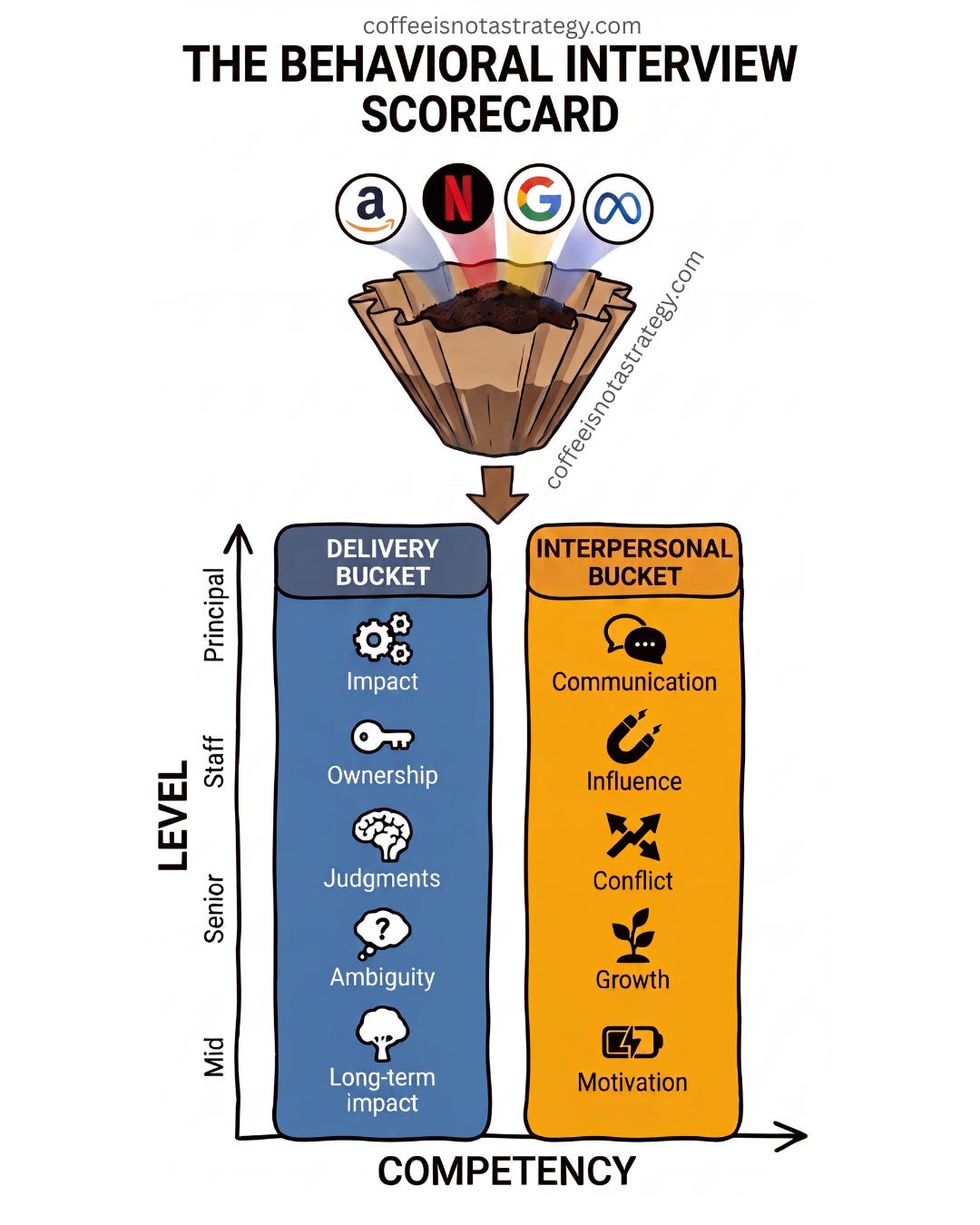
Axis 1 - Competency
There are more or less the same 10 competencies that sit underneath every company’s fancy cultural values. They fall into 2 buckets:
Delivery: impact, ownership, judgment, ambiguity, long-term impact.
Interpersonal: communication, influence, conflict, growth, motivation.
Every company dresses these up in its own house style - Amazon has 16 Leadership Principles, Netflix has an elaborate culture memo with 4 core principles and 8 values, Meta and Google have 4 or 5 consolidated focus areas but the scoring underneath fans out to the same competencies.
If you prep these 10, you've done most (about 85%) of the work for any of them.
The two most common rejection lines map cleanly onto these buckets - “didn’t demonstrate senior scope” means you were thin on the delivery half. “leadership concerns” or “culture fit” almost always means you didn’t give enough signals for the second bucket.
Axis 2 - Level
The 10 competencies don’t change as you go up the ladder. “I built the caching layer“ and “I got three teams onto a shared caching layer“ are the same competency, shown at two very different levels. Missing the nuances of this is why two people can tell the same story and get leveled a rung apart.
If you’ve ever been down-leveled, this post is a must-read:

Get rest of this for FREE by signing up: all 10 competencies broken down with the what works and what doesn’t, how the bar changes from senior to principal, how Amazon, Meta, Google, and Netflix each grade differently, and what changes if you’re a manager.